Introducing trombone soloist Helen Vollam
Blog ·
As soon as the first draft of the Season 2026 brochure landed last winter, there was a palpable air of excitement in the QSO offices. Amongst the proposed concerts were some real gems: featuring unusual repertoire the musicians were excited to get their hands on the sheet music for, as well as some old favourites with storied lore passed down from the longer-standing members of the orchestra. A few soloist names drew oohs and ahs from those of us who had been long impressed and inspired by their work. Many of these excitements converged in one concert: Respighi, Higgins & Strauss.
This concert seemed to have it all - beloved, rich and colourful tone poems by master orchestrators Richard Strauss and Ottorino Respighi, a new and obscure concerto by a living composer featuring a rarely-platformed brass instrument, and the virtuosic trombone genius to perform it, who had inspired so many of our own players. Alas, last week, disaster struck: soloist Jörgen van Rijen was ruled out by an injury which means he cannot travel to Australia.
The mood in the QSO office became sombre. In preparing for the concert - writing the marketing copy, preparing the scores and parts, speaking to its composer Gavin Higgins on the other side of the globe - we had started to look forward to experiencing this wonderful piece live for the first time on stage at QPAC. Surely at this short notice, there would be nobody else who could play it - the piece would have to be pulled from the program and replaced with something easier.
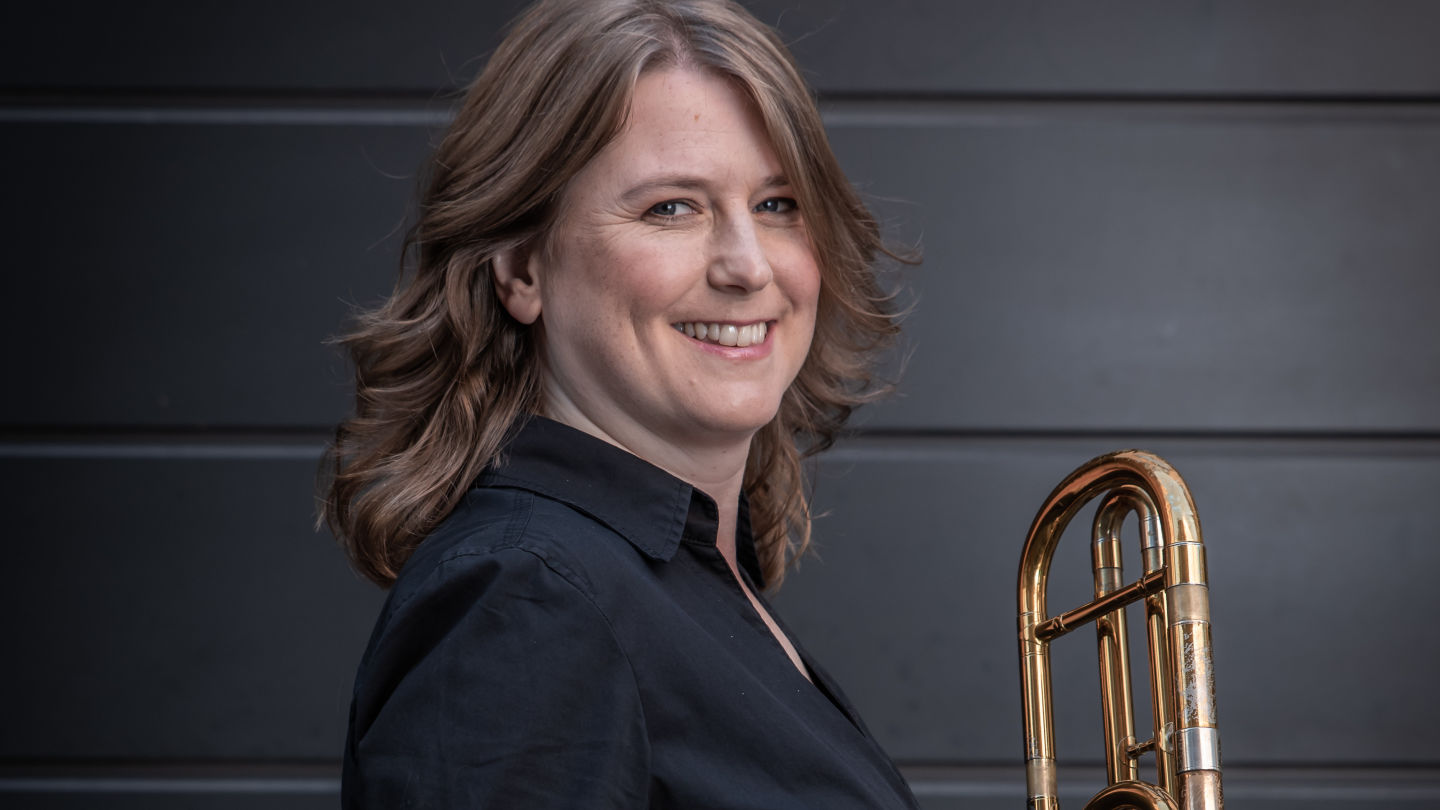
Enter our trombone hero: Helen Vollam.
Helen is not only the Principal Trombone at the BBC Symphony Orchestra in London, and the first female musician to be appointed Principal Trombone of a London orchestra, but also the dedicatee of the piece, who had a great hand in shaping its twists and turns. She performed the world premiere of the piece in London in 2019, and remains to this day the only person who has performed it on the professional stage.
In an interview with the British Trombone Society while he was still writing the piece, Gavin discussed Helen's influence on it:
"Every time I write something, I send it to [Helen] to have a go at – I’m writing a piece for her and the BBC Symphony, so I want to make sure it’s a piece she’s happy playing. Certain players have things they enjoy doing and things they don’t enjoy doing. So there’s been quite a lot of back and forth, which is good as I think the first sketch I sent her was verging on impossible! (Which is fine, my feeling is to get it all down first and clear out what doesn’t need to be there later.) We met up a few times, and tried things out. I’m a brass player, but I’m not a trombone player. I know the slide positions, but I don’t really know what the actuality of doing some of these things in real time is, so it’s been quite useful.
So often you’re sent off to do your thing and you hand it in at the end, which is quite a lonely process. But if you’re writing a concerto for a specific player, I think it’s important that you have a lot of contact with that person. Also, I think it puts Helen’s mind at rest, that I’m not just handing her a massive 24 minute concerto at the end of the process, and she’s actually getting to see it as it comes along."
The piece uses a huge orchestra: 40 strings, 12 winds, 11 brass, two harps, a piano and a celeste, and a five-strong percussion section including two sets of tubular bells. The movements are named for celestial phenomena including comets, an eclipse, and parhelia (commonly known as sundogs or mock suns, these are atmospheric optical phenomena appearing as bright, sometimes colorful spots on either side of the sun), while the final movement is simply called Beasts. The third movement, Eclipse, features a no-holds-barred cadenza (historically an unaccompanied bravura passage introduced at or near the close of a movement of a composition and serving as a brilliant climax).
Gavin described the challenges of writing for the trombone:
"When you think of a concerto you naturally think of extreme virtuosity. This piece is virtuosic, it’s quite a blow, there’s a lot going on, but it’s not the same type of virtuosity as on a violin or a clarinet. You have to readjust your head to the instrument, what it can do, what it sounds good doing, where the line is of what’s actually playable and what isn’t. Things like needing breaks and time to breathe and all the other things you have to take into consideration.
There are a few different mutes, and the end of the cadenza is sort of a glissando fantasy, full of glissandos and rips – but nothing too wacky! We played around with multi-phonics, but the music that I had in my head, and what needed to be done for it to work effectively didn’t quite match up, so we left that.
Helen’s such a classy player. At the very beginning she was adamant she wanted to be able to play everything, which is not to say ‘don’t make it hard’; she wanted to make sure every note was there. She wasn’t interested in bluffing, which is quite a nice thing to hear. So it’s nice to be working with someone who is very clear that what’s there is what she wants to play."
The media response to the premiere of the piece was glowing, with the Times praising Helen's "bronzed tone and even phrasing", and Bachtrack claiming "Helen Vollam's amazing playing seemed to make light of any difficulties". The piece won an Ivor Novello award in 2019.
If you think this concert will be your first experience of Helen's playing, you can probably think again. She has graced soundtracks including Harry Potter, Guardians of the Galaxy, Brave, Inception and Star Wars, and recorded with household names such as John Williams, Bryn Terfel, Natalie Cole and Paul Weller.
The entirety of QSO is delighted to be working with Helen, and our excitement for this concert has been restored. We hope you will join us.